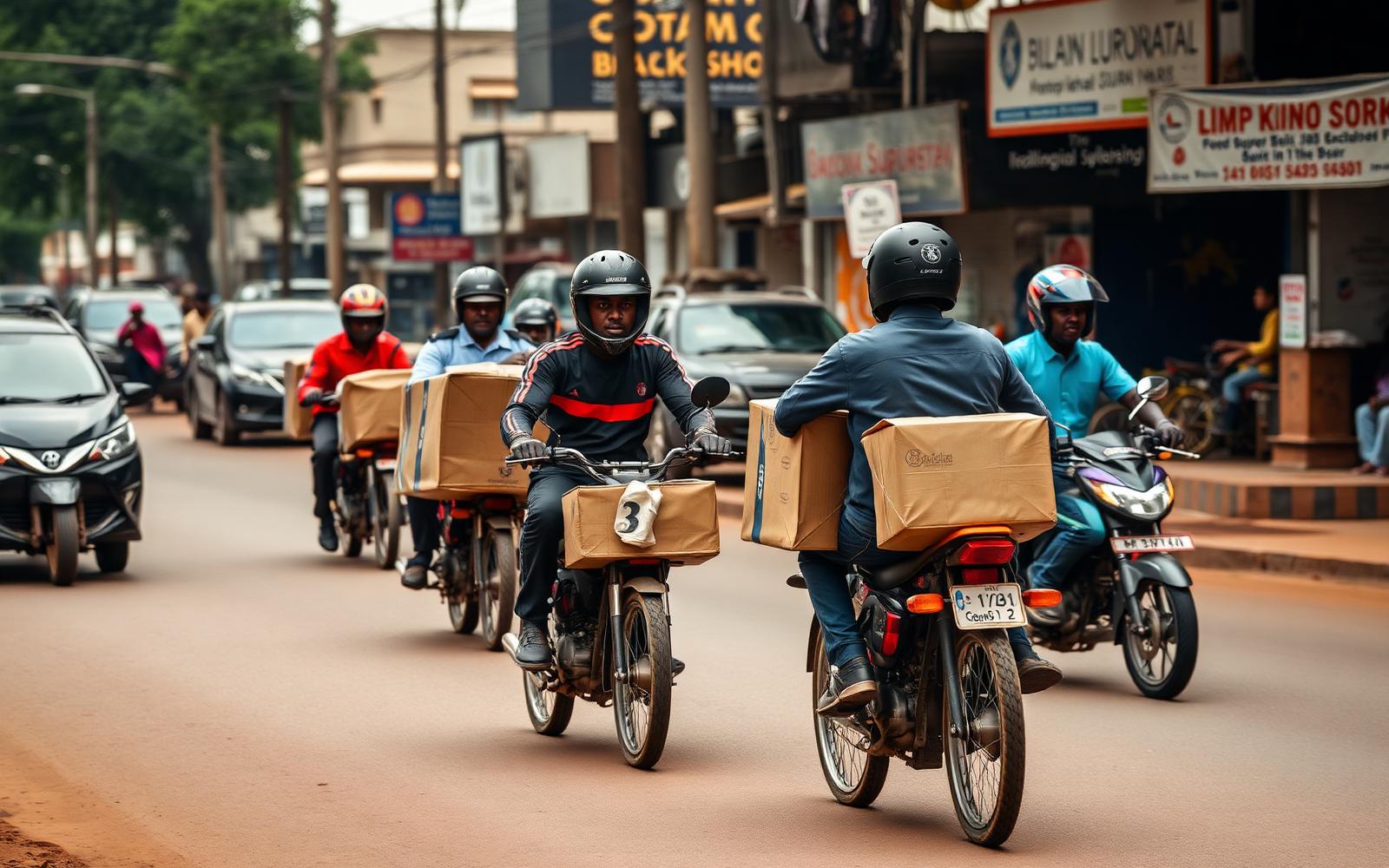
The Last Kilometre Problem: AI Routing for Roads Without Addresses
Commercial routing engines assume an address system most African cities do not use. Deliveries are found by landmark, by phone call, by a rider who knows the lane.
Commercial routing engines assume an address system that most African cities do not use. Deliveries in Kampala or Lagos are found by landmark, by phone call, by a boda rider who knows which unnamed lane floods after rain.
Importing an optimiser built for numbered streets produces routes that look efficient on a screen and fail on the ground.
Build the address layer as you operate
The practical approach is to capture verified drop-point coordinates on every successful delivery, cluster them into a proprietary landmark graph, and let rider behaviour correct the map continuously. After a few thousand deliveries an operator has something no mapping vendor sells: a ground-truth address book for its own customer base.
This is a compounding asset. It gets more accurate with volume, it is specific to the areas the business actually serves, and it is very difficult for a new entrant to replicate quickly.
A route a rider declines is not an optimisation. It is a failed dispatch.
Rider incentives are part of the optimisation
Pure distance minimisation produces routes riders refuse, long unpaid repositioning legs, drop sequences that end far from the next likely pickup, assignments through areas riders avoid after dark. A route a rider declines is not an optimisation; it is a failed dispatch and an unhappy customer.
Dispatch models therefore have to include earnings per hour, repositioning cost, and acceptance probability as first-class objectives. Operators that model rider behaviour explicitly see acceptance rates rise without raising per-trip pay.
Cross-border freight is the bigger prize
For freight, delay rather than distance is the real cost. Document classification, pre-clearance preparation, and predicting inspection likelihood can remove days at Malaba, Busia, or Beitbridge. A truck sitting for three days at a border burns driver cost, capital, and customer patience in a way no route optimisation recovers.
This work is document-heavy and unglamorous, extracting and validating fields from certificates, manifests, and permits, and it has among the clearest returns in African logistics.
Instrument capture first
Most operators discover, when they finally attempt modelling, that they never recorded actual drop coordinates, actual arrival times, or the reason a delivery failed. Those three fields are the foundation of everything above, and adding them costs a sprint of app work rather than a data science programme.
What this means in practice
- Capture verified drop coordinates, actual arrival times, and structured failure reasons on every delivery starting now.
- Build the landmark graph from your own delivery history rather than licensing an address dataset that does not match reality.
- Include rider earnings and acceptance probability as explicit objectives in dispatch, not as an afterthought.
- For freight, target border dwell time with document automation before investing in route optimisation.
Frequently asked questions
- What is this analysis about?
- Commercial routing engines assume an address system most African cities do not use. Deliveries are found by landmark, by phone call, by a rider who knows the lane.
- What is the core argument?
- Commercial routing engines assume an address system that most African cities do not use. Deliveries in Kampala or Lagos are found by landmark, by phone call, by a boda rider who knows which unnamed lane floods after rain.
- Build the address layer as you operate?
- The practical approach is to capture verified drop-point coordinates on every successful delivery, cluster them into a proprietary landmark graph, and let rider behaviour correct the map continuously. After a few thousand deliveries an operator has something no mapping vendor sells: a ground-truth address book for its own customer base.
- What should our organisation do about it?
- Capture verified drop coordinates, actual arrival times, and structured failure reasons on every delivery starting now. Build the landmark graph from your own delivery history rather than licensing an address dataset that does not match reality. Include rider earnings and acceptance probability as explicit objectives in dispatch, not as an afterthought. For freight, target border dwell time with document automation before investing in route optimisation.
- Who published this and can we discuss it with Kwish?
- Kwish Research Team at Kwish Technologies published this on April 2026. Kwish works on logistics programmes from offices in Uganda, Kenya, Sweden and Canada, and you can reach the team at info@kwishtechnologies.com.
Keep exploring
Turn this analysis into delivery
The services, sectors and case studies connected to this article.
Services that deliver this
Sectors where this applies
Related insights

Why African Governments Need AI-Native Systems, Not Retrofits
The temptation when modernising government technology is to retrofit. That instinct is exactly what Africa cannot afford.

The Hidden AI Infrastructure Gap in East African Universities
Faculty want AI in the classroom. IT departments don't have the data plumbing to deliver it. Here's the gap nobody is funding.

Building Government-Grade AI in Uganda: 5 Lessons from the Field
Procurement compliance. Stakeholder management. Data sovereignty. Local language requirements. Long-term maintenance planning.
Want this applied to your organisation?
Send us the decision you are trying to make. We reply with a scoped quotation.
Most quotations answered within one business day.