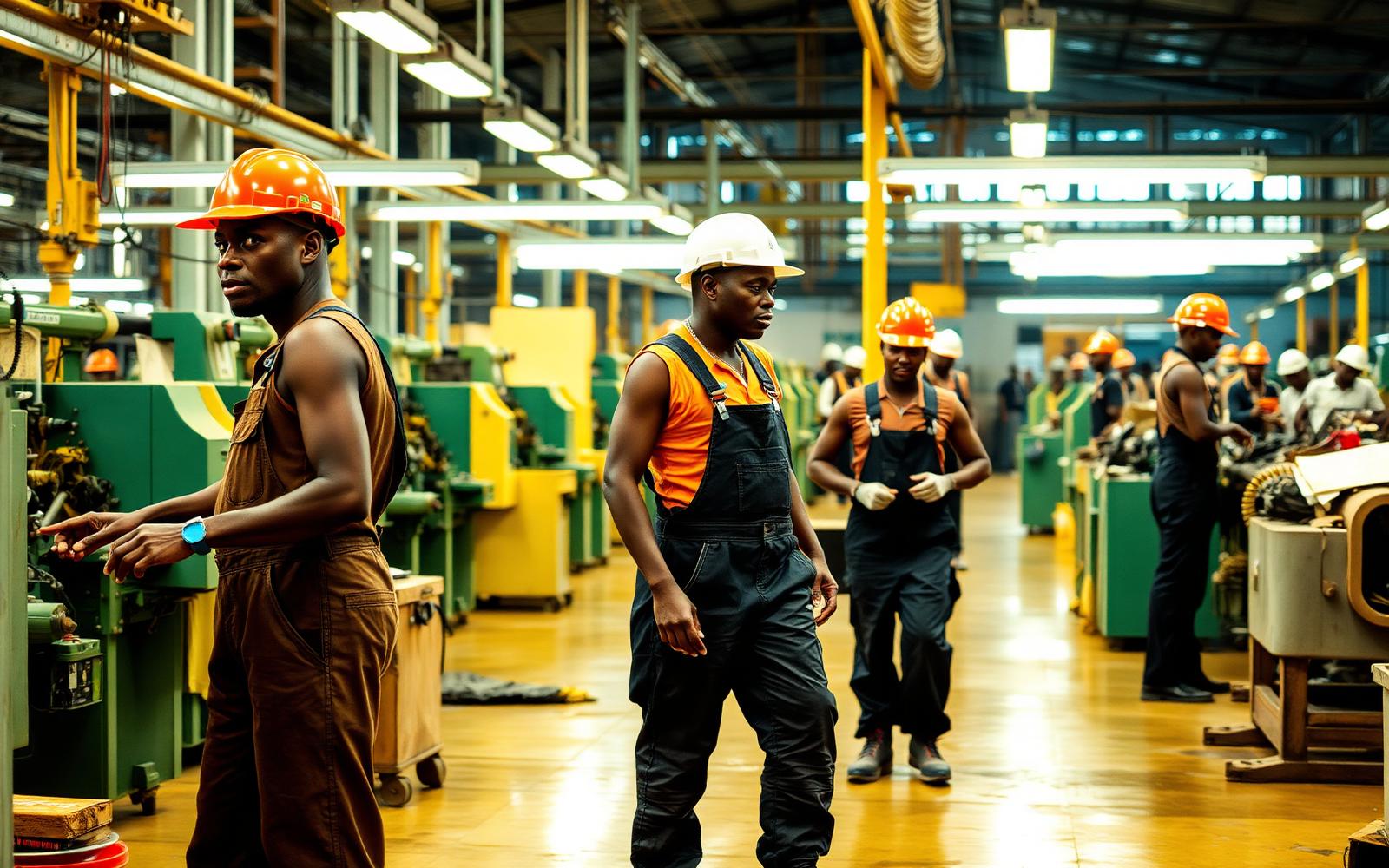
Predictive Maintenance for Factories That Can't Afford Downtime, or Sensors
Vendor decks assume a plant instrumented to the bearing. Most African factories run second-hand lines with no telemetry and no maintenance history.
Predictive maintenance sales decks assume a plant already instrumented to the bearing. Most African factories run imported second-hand lines with no telemetry, no maintenance history worth modelling, and a capex committee that will not approve a sensor programme on a vendor's promise.
That does not make the opportunity theoretical. It changes the entry point.
Instrument the assets whose failure stops the line
Every plant has two or three machines whose failure halts production entirely. Retrofit vibration and thermal sensors on those, log failures properly for two quarters, and you have a dataset that justifies the next tranche on measured downtime avoided rather than on a vendor's claim.
The discipline that matters most in those two quarters is failure logging: what stopped, when, why, how long, and what it cost in lost output. Most plants have this information distributed across a supervisor's memory and a shift book, which is to say they do not have it.
Plants that skip the baseline cannot prove improvement, which is how promising pilots quietly lose their budget.
Vision-based quality control is often the faster win
A camera and a small classifier can catch defect rates that manual inspection misses at line speed, and the payback is visible in a single production run. It requires no machine telemetry, no retrofit engineering, and no downtime to install.
For plants where scrap and rework are the dominant loss, this is the correct first project, and it produces the internal confidence needed to fund the maintenance programme afterwards.
The strategic case sits above the plant floor
AfCFTA rewards manufacturers who can prove consistent quality and delivery reliability to buyers across borders. Documented defect rates and on-time performance are becoming procurement requirements, not marketing claims.
That reframes instrumentation. It is not only a cost-reduction exercise; it is the evidence base for winning regional contracts against competitors who can only assert quality.
Measure before you touch anything
Establish the downtime and scrap baseline before installation. Plants that skip this cannot prove improvement afterwards, which is how promising pilots quietly lose their budget in the following year's review.
What this means in practice
- Identify the two or three assets whose failure stops the line and instrument only those first.
- Start disciplined failure logging, cause, duration, lost output, this month, with or without sensors.
- If scrap and rework dominate losses, deploy vision-based quality control before predictive maintenance.
- Record the downtime and scrap baseline before installation, and report against it quarterly to the capex committee.
Frequently asked questions
- What is this analysis about?
- Vendor decks assume a plant instrumented to the bearing. Most African factories run second-hand lines with no telemetry and no maintenance history.
- What is the core argument?
- Predictive maintenance sales decks assume a plant already instrumented to the bearing. Most African factories run imported second-hand lines with no telemetry, no maintenance history worth modelling, and a capex committee that will not approve a sensor programme on a vendor's promise.
- Instrument the assets whose failure stops the line?
- Every plant has two or three machines whose failure halts production entirely. Retrofit vibration and thermal sensors on those, log failures properly for two quarters, and you have a dataset that justifies the next tranche on measured downtime avoided rather than on a vendor's claim.
- What should our organisation do about it?
- Identify the two or three assets whose failure stops the line and instrument only those first. Start disciplined failure logging, cause, duration, lost output, this month, with or without sensors. If scrap and rework dominate losses, deploy vision-based quality control before predictive maintenance. Record the downtime and scrap baseline before installation, and report against it quarterly to the capex committee.
- Who published this and can we discuss it with Kwish?
- Kwish Research Team at Kwish Technologies published this on April 2026. Kwish works on manufacturing programmes from offices in Uganda, Kenya, Sweden and Canada, and you can reach the team at info@kwishtechnologies.com.
Keep exploring
Turn this analysis into delivery
The services, sectors and case studies connected to this article.
Services that deliver this
Sectors where this applies
Related insights
Why African Governments Need AI-Native Systems, Not Retrofits
The temptation when modernising government technology is to retrofit. That instinct is exactly what Africa cannot afford.

The Hidden AI Infrastructure Gap in East African Universities
Faculty want AI in the classroom. IT departments don't have the data plumbing to deliver it. Here's the gap nobody is funding.

Building Government-Grade AI in Uganda: 5 Lessons from the Field
Procurement compliance. Stakeholder management. Data sovereignty. Local language requirements. Long-term maintenance planning.
Want this applied to your organisation?
Send us the decision you are trying to make. We reply with a scoped quotation.
Most quotations answered within one business day.